





A Commission Built for History
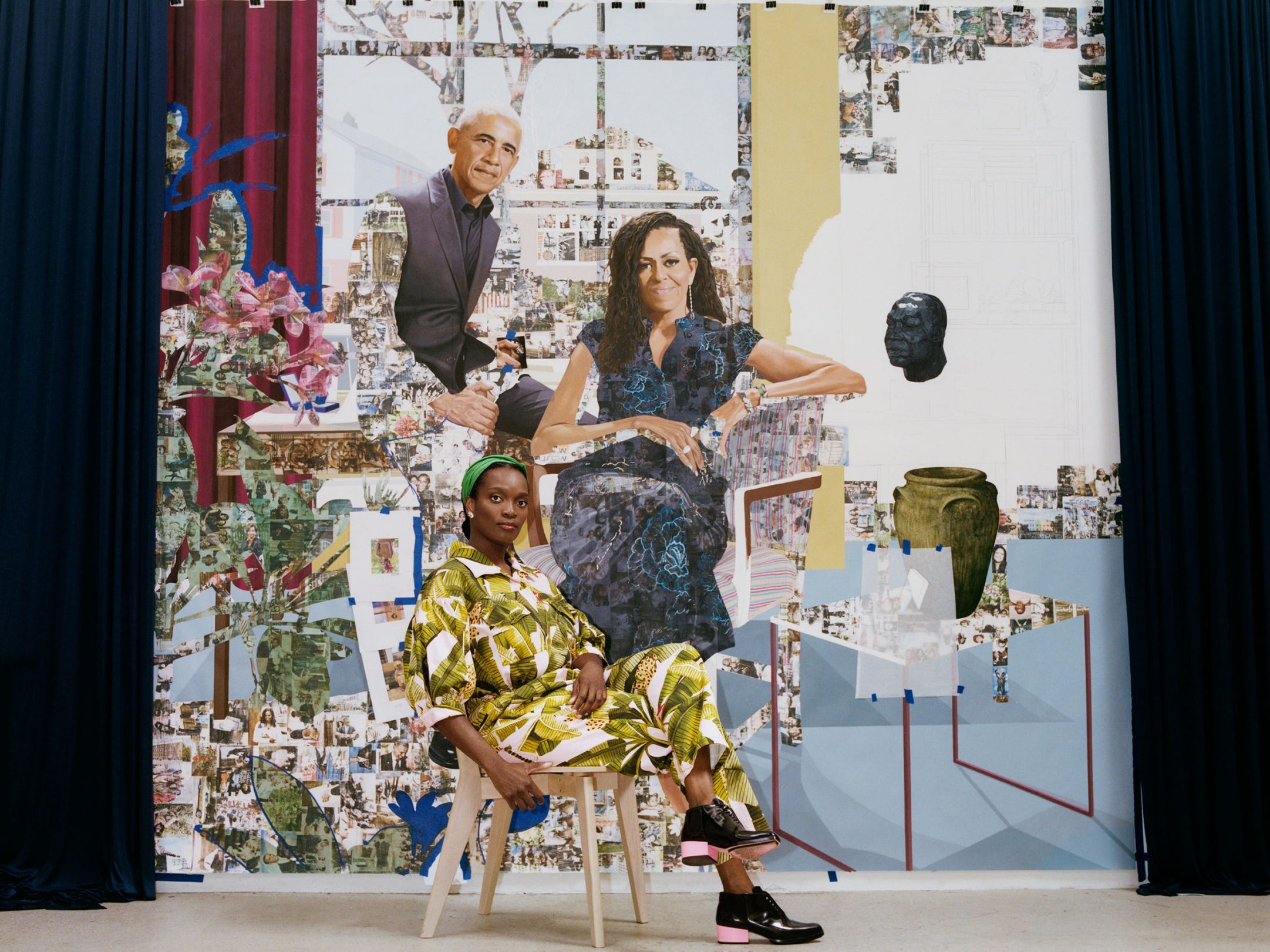
When the Obama Presidential Center opens in Chicago, visitors will encounter something no institution has ever produced before: an official joint portrait of Barack and Michelle Obama, painted together in a single composition. The work was commissioned specifically for the center, and the artist behind it is Njideka Akunyili Crosby, the Nigerian-born, Los Angeles-based painter whose layered, photo-transfer canvases have made her one of the most sought-after voices in contemporary art over the past decade.
Akunyili Crosby came to the project with a practice already defined by intimacy and cultural duality – her paintings routinely collapse domestic Nigerian interiors with Western art historical references, building dense surfaces that feel simultaneously personal and monumental. That existing visual vocabulary, it turns out, was exactly what a portrait of two people who reshaped global cultural identity demanded.
Why This Portrait Is Different From Any Other Presidential Image
Official presidential portraiture has a long and relatively rigid tradition in the United States. Subjects are typically rendered alone, formal, framed against draped fabric or institutional backdrops. The National Portrait Gallery’s individual portraits of Barack Obama by Kehinde Wiley and Michelle Obama by Amy Sherald already broke significantly from that tradition – Wiley placed the former president against flowering botanical vines, while Sherald rendered the former first lady in a voluminous gray gown against a sky-blue ground. Those two commissions, unveiled in 2018, generated cultural conversation that extended far beyond the art world and into fashion, identity politics, and the question of who gets to be commemorated and how.
The new Akunyili Crosby commission operates differently. This is not a state portrait for a government institution – it belongs to the Obama Presidential Center, a privately funded civic project on Chicago’s South Side. That distinction gives the work a different kind of freedom. Akunyili Crosby has described drawing on instinct as much as research when approaching the composition, allowing her personal relationship to image-making and to the cultural weight the Obamas carry to guide the decisions about how the two figures sit in relation to each other and to the viewer.
Her process is characteristically layered, both literally and conceptually. Akunyili Crosby builds her canvases using photo-transfer techniques, embedding printed imagery – culled from magazines, family archives, newspapers – beneath painted surfaces. The result is a kind of visual stratigraphy, where meaning accumulates in depth rather than being stated on the surface. Applied to a portrait of this magnitude, that method transforms what could have been a straightforward commemoration into something closer to a cultural excavation.
What she chose to foreground and what she allowed to recede into the photographic underlayers are decisions that will reward close attention once the center opens. The instincts she has spoken about – the ones that guided composition, palette, and the relationship between the two figures – are the same instincts that have driven her commercial gallery success and her museum acquisitions internationally. This portrait is not a departure from her practice. It is an extension of it into a space of enormous public visibility.
Fashion, Identity, and the Portrait Frame
For readers who track the intersection of fashion and cultural power, a joint portrait of the Obamas carries specific weight. Michelle Obama’s clothing choices during her eight years as first lady were dissected, celebrated, and criticized with an intensity that no previous occupant of that role had experienced at the same scale. Designers from Jason Wu to Naeem Khan to Prabal Gurung became household names in significant part because she wore them. The way she dressed was understood, by her own account, as deliberate communication – about American manufacturing, about diversity in the fashion industry, about joy as a political statement.
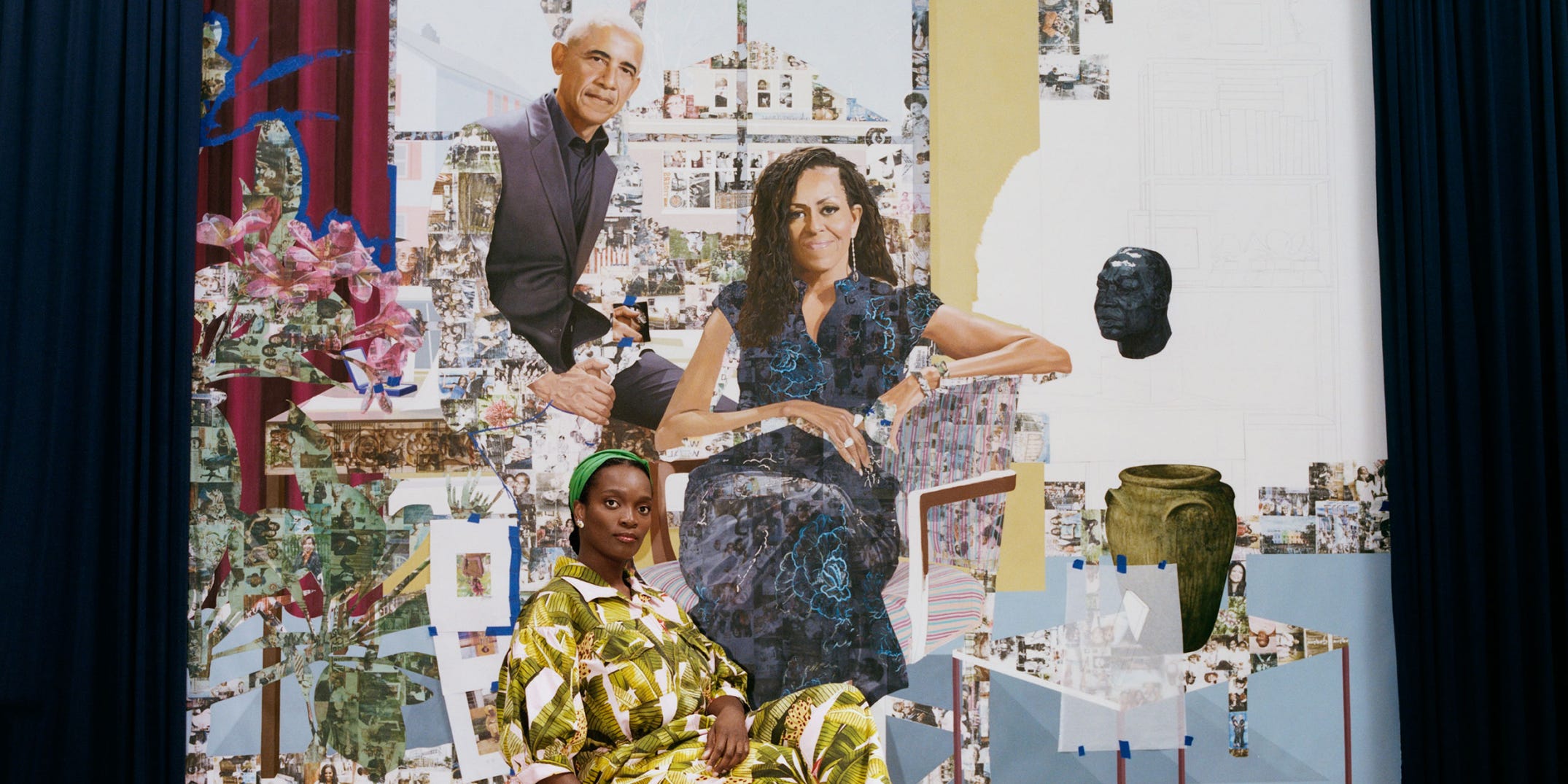
How Akunyili Crosby chose to render both figures in terms of clothing, color, and physical presence within the frame is not a trivial detail. In portrait painting, what a subject wears encodes status, era, and intention with as much specificity as a runway look does. The Sherald portrait’s choice to dress Michelle Obama in a gown that absorbed and reflected light in an almost sculptural way was as much a fashion decision as an artistic one. Akunyili Crosby’s own sensibility around fabric, pattern, and textile – evident throughout her broader body of work, which frequently renders Ankara prints and domestic textiles with documentary precision – suggests she would approach the question of dress in this commission with the same deliberateness.
Chicago as the Work’s True Context
The Obama Presidential Center is being built in Jackson Park on Chicago’s South Side, a predominantly Black neighborhood that has had a complicated relationship with the project’s development since it was announced. The center will include a museum, library programming, and public green space, and it has been described by its architects, Tod Williams Billie Tsien Architects, as a civic gathering space as much as a memorial institution. Placing Akunyili Crosby’s portrait at the center of that project connects the work to a specific geography – not Washington, not New York, but the South Side of Chicago, where Barack Obama organized communities and where Michelle Obama grew up.
Akunyili Crosby’s own biography adds another layer. Born in Nigeria and based in Los Angeles, she occupies a position between multiple cultural worlds, which has always been the engine of her work. The commission places an artist whose practice is built on navigating cultural duality in direct conversation with two subjects whose public lives have been defined by exactly the same navigation. That alignment is not incidental.
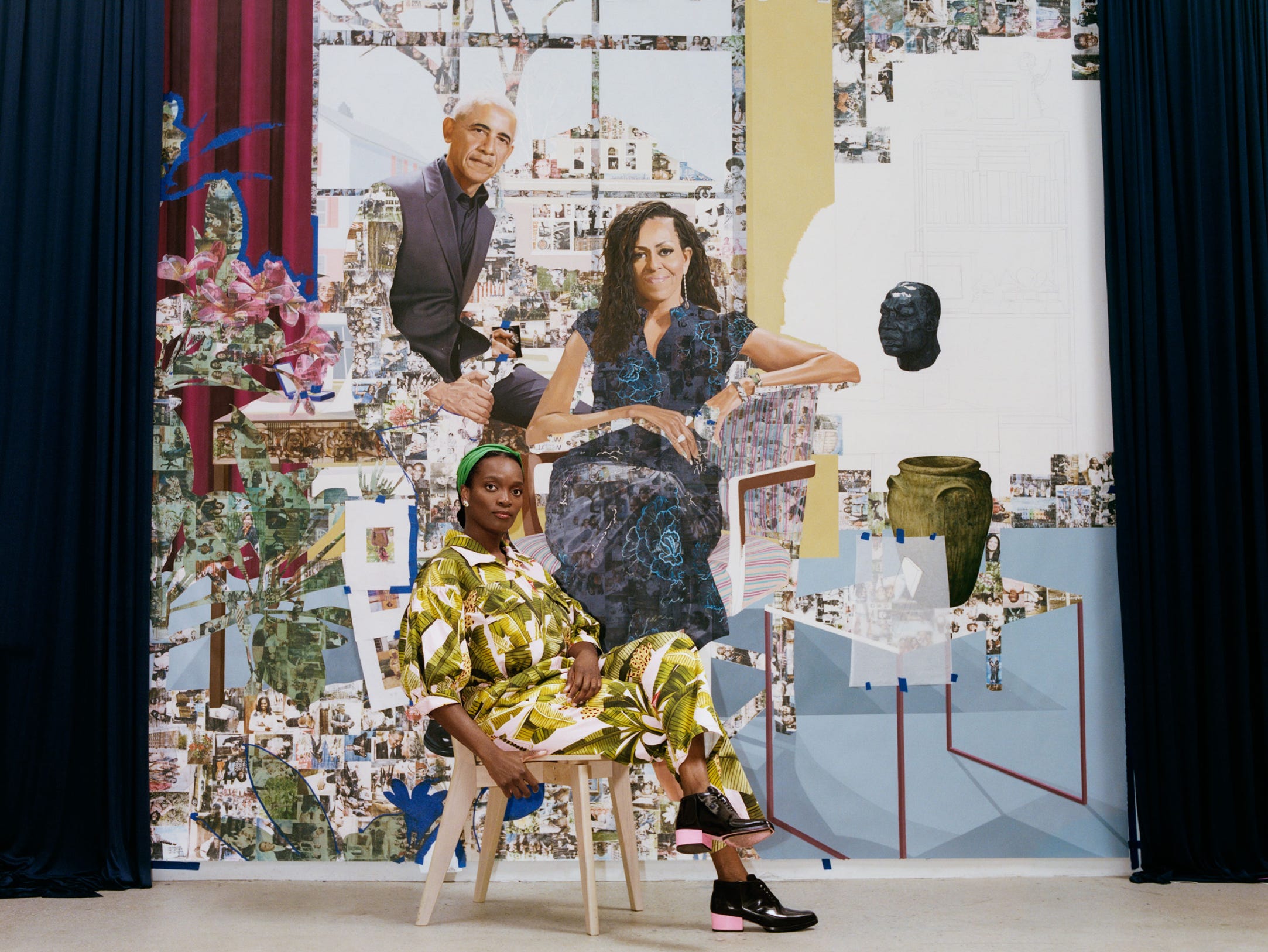
The portrait has not yet been publicly exhibited at the time of this writing. When the Obama Presidential Center opens, the work will become one of the most viewed paintings in the United States, not because of its gallery placement but because of the foot traffic a presidential center generates from audiences who may have little regular engagement with contemporary art. Akunyili Crosby’s layered, photo-transfer surfaces – which reward sustained, close looking – will meet viewers arriving with every conceivable expectation.
The question of whether a painting built for attentive, intimate viewing survives translation to a high-volume civic space is one every museum curator wrestles with. Akunyili Crosby has spoken about the instincts that drove her choices here. Those instincts have worked in gallery contexts and in museum retrospectives. Whether they hold at presidential-center scale – and what the work looks like when a visitor from the South Side of Chicago stands in front of it for the first time – is a pressure test that no amount of critical context fully anticipates.