





A Designer Between Two Audiences
Elie Saab’s Spring 2027 collection arrived at a particular moment – right as the house prepares to launch a collaboration with H&M, a move that will put the Saab name in front of millions of shoppers who have never stepped inside a couture atelier.
The Archive as Starting Point
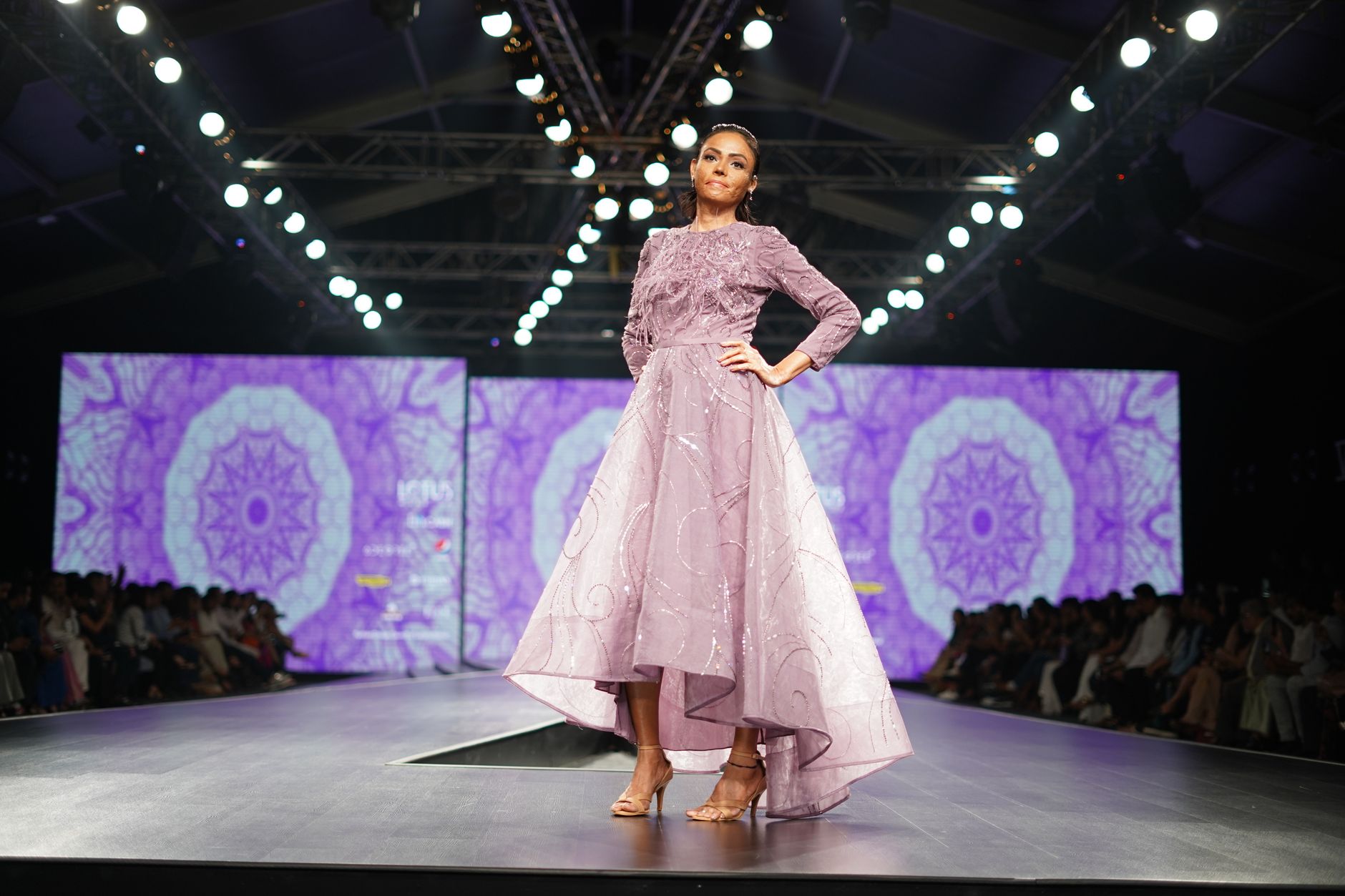
The collection drew directly from Saab’s early 2000s archives. That era defined what most people picture when they hear the name Elie Saab – bias-cut evening gowns, intricate beading, a kind of red-carpet femininity that dominated the years just after his 2001 Oscar moment with Halle Berry. Returning to it now is not nostalgia for its own sake. It reads as a deliberate recalibration, pulling the house back to its clearest identity before broader commercial exposure potentially diffuses it.
What the early 2000s archive offers, and what Spring 2027 attempts to translate, is a kind of controlled delicacy. The clothes from that period were not minimalist – they were intensely constructed, but in a way that felt effortless on the body. Whether the new collection fully recaptures that balance is the question worth sitting with. Archive mining works best when it finds what still holds tension, not simply what looked beautiful in photographs twenty-odd years ago.
Saab designed this collection with a new generation explicitly in mind. That framing matters because it changes what “archive” means in this context. He is not presenting these references to long-time clients who remember the originals. He is presenting them to women – and a broader audience – for whom the early 2000s are increasingly vintage territory, a decade being reconsidered aesthetically across fashion right now. The timing, whether calculated or not, aligns with a wider cultural moment in which that era is being actively re-evaluated.
The word “delicate” appeared in the house’s own framing of the collection, and it is an honest one. The garments lean into the fine, the sheer, the intricately wrought. There is nothing aggressive or deconstructed here. Saab has never worked in provocation, and Spring 2027 is consistent with that – the clothes are meant to be beautiful in a legible, immediate way, which is both their strength and the thing that leaves certain critics wanting more friction.
What the H&M Deal Changes
The H&M collaboration, announced alongside this collection cycle, is not a minor footnote. H&M designer partnerships have historically moved enormous volume and reshaped how a house is perceived at the popular level, sometimes permanently. Saab’s timing – releasing a collection rooted in the period that made him famous, then preparing to distribute a version of that identity through one of the world’s largest fast-fashion retailers – suggests a deliberate sequencing. Establish the source material. Then widen the reach.
For houses that have done this successfully, the key has been maintaining enough distinction between the couture or ready-to-wear line and the mass collaboration that the two feel like different registers of the same language, not a single diluted product. Saab’s Spring 2027 runway exists, in part, to define what that upper register looks like before the H&M version arrives. It is the benchmark against which the collaboration will inevitably be read.
The risk is real. When a designer’s name becomes familiar to a dramatically larger audience through a budget collaboration, the perception of exclusivity – which underpins luxury pricing across every category – can erode in ways that take years to rebuild. Saab’s team is clearly aware of this. The choice to go back to the early 2000s archive, to present something that reads as historically grounded rather than trend-chasing, is partly a protective move. It says: this is where we come from, and that origin has weight.
That said, H&M partnerships have also introduced designers to genuinely new clients who then migrate upward. Customers who buy the H&M version at 29 euros sometimes become, years later, the clients who attend trunk shows. The pipeline argument has real precedent. Whether Saab’s particular aesthetic – which is more occasion-wear and evening-focused than many H&M collaborators – translates to that broader, younger audience at the mass-market price point is unclear. The categories that work in couture do not always survive the translation to high-street sizing, production timelines, and margin requirements.
Saab built his reputation on a very specific kind of garment: heavily embellished, body-conscious, designed for high-stakes moments. That specificity is what made him a red-carpet fixture and a favorite for formal wear across the Middle East and beyond. The Spring 2027 collection reinforces that identity – delicate, technically accomplished, rooted in a singular visual language. The H&M collaboration will have to find a way to gesture toward that language without requiring the hand-finishing and material cost that makes it function at the couture level. That is a real design problem, not a marketing one.
Where the Collection Lands
Spring 2027 is not a reinvention. Saab is not interested in reinvention, and this collection does not pretend to be one. What it does is revisit the ground where his work has always been most confident – the delicate, the precise, the deliberately feminine – and present that to a generation encountering it without the context of the original moment.
The more interesting question, the one that will take another year to answer, is whether the Spring 2027 runway will look like an anchor or an afterthought once the H&M campaign launches and the Saab name reaches a scale it has never operated at before. A house can hold two audiences – but rarely with the same collection, and rarely without deciding, at some point, which one it is actually designing for.