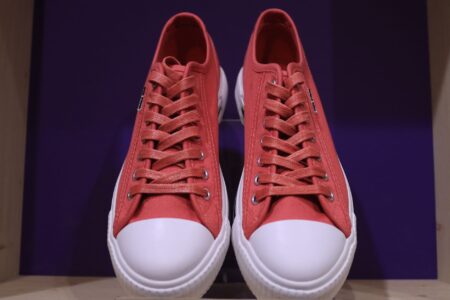





A Decade of Quiet Dominance
Luisa Dames did not build Aeyde by chasing trends or flooding the market with seasonal noise. Over the past ten years, the founder and CEO grew the Berlin-based footwear label into a cult brand through an operating philosophy centered on focus and clarity – two qualities that are genuinely rare in an industry that rewards volume and visibility above almost everything else.
Organic growth, sustained over a full decade, is the headline.
That kind of trajectory does not happen by accident. It happens when a founder holds a razor-sharp vision consistently enough that the brand develops its own gravitational pull – customers arrive because the product is exactly what it promises to be, not because a campaign told them it should be. Aeyde occupies that specific territory: a label with a defined aesthetic identity that has compounded credibility year over year without losing the thread of what it originally set out to do.
What Clarity Actually Looks Like at the Top
Dames is currently evolving her leadership style, which signals that the business itself has matured past its founding phase. Early-stage companies often run entirely on the founder’s instinct – every decision filtered through one person’s taste and judgment. Scaling that model without diluting it is where most independent labels struggle, and where Dames appears to be doing real strategic work. Evolving as a leader while the brand stays anchored to its original mission requires a specific kind of discipline: knowing which things should change and which things absolutely should not.
The footwear category is brutally competitive at every price point, and the mid-to-luxury segment where Aeyde operates is no exception. Larger houses with enormous marketing budgets and wholesale infrastructure compete for the same customer. Independent brands that survive a decade in that environment without compromising their positioning or selling to a conglomerate have usually done so because the founder refused to optimize for short-term metrics at the expense of long-term identity. Dames fits that profile.
Focus, in practical business terms, means saying no constantly. It means declining collaborations that would generate coverage but dilute the brand’s signal. It means resisting the pressure to expand categories before the core product is saturated. Whether Aeyde has navigated all of those pressure points successfully over ten years is visible in the result: a brand that still reads as intentional, not scattered.
The Organic Growth Model and Why It’s Hard to Replicate
Organic growth is frequently invoked as a virtue in fashion branding, but it’s worth being specific about what it actually requires. For Aeyde, building without aggressive paid acquisition or blockbuster wholesale deals means the brand’s reputation had to do the heavy lifting. Word of mouth, editorial placement, and a product that genuinely retains customers – those are the mechanisms. Each one is slower and less controllable than a paid growth lever, which is precisely why brands that achieve it end up with a more durable customer base.
Dames has stayed true to the business’s mission throughout this period – a phrase that sounds simple but describes something operationally difficult. Mission drift in fashion usually begins with a reasonable compromise: a slightly more commercial silhouette here, a licensed product there, a collaboration chosen for reach rather than fit. Those individual decisions rarely feel significant in the moment, and collectively they can hollow out a brand within a few seasons. The fact that Aeyde still carries its original character after ten years suggests those compromises were either avoided or tightly managed.
The independent footwear space has seen significant consolidation and brand fatigue over the past several years, with consumers becoming increasingly selective about which labels actually earn sustained attention versus which ones are simply well-distributed. Aeyde’s position as a cult brand rather than a mass-market one is a deliberate outcome, not a limitation – it reflects a choice to be deeply relevant to a specific customer rather than moderately relevant to a broad one.

Where the Brand Goes From Here
Dames is actively working through the leadership evolution that comes when a founder-led company reaches a point where systems and teams need to carry more of what the founder once carried alone. That transition is one of the more consequential inflection points any independent brand faces. Done well, it extends the founder’s vision into the organization’s structure. Done poorly, it creates a gap between what the brand says it is and what it actually produces. Dames has ten years of consistent output as evidence that she understands the difference – which is exactly why the current evolution of her leadership approach is worth watching closely. The pressure at this stage is different from the pressure at launch: it is no longer about proving the concept, it is about institutionalizing it without killing what made it work in the first place.
Aeyde enters its next decade with a customer base that chose the brand deliberately, a positioning that has not been traded away for scale, and a founder who is openly rethinking how she leads without suggesting she is rethinking what she is building toward.
The question is whether that kind of intentional restraint can survive the specific temptations that come with a brand at exactly this stage of its life – established enough to attract acquisition interest, cultish enough to lose everything if the wrong door gets opened.