





Content warning: This article discusses sexual assault as depicted in the Prime Video series Off Campus, and may be distressing for some readers. Spoilers for Episode 4 follow.
Off Campus arrived on Prime Video marketed as a hockey romance – hot, tension-filled, the kind of show you binge in a weekend with your friends texting you timestamps. Ella Bright plays Hannah Wells opposite Belmont Cameli’s Garrett Graham, and the chemistry between them is the obvious draw. The secondary pairing of Allie Hayes (Mika Abdalla) and Dean Di Laurentis (Stephen Kalyn) adds another layer of yearning to an already charged ensemble. What nobody quite warned viewers about was Episode 4.
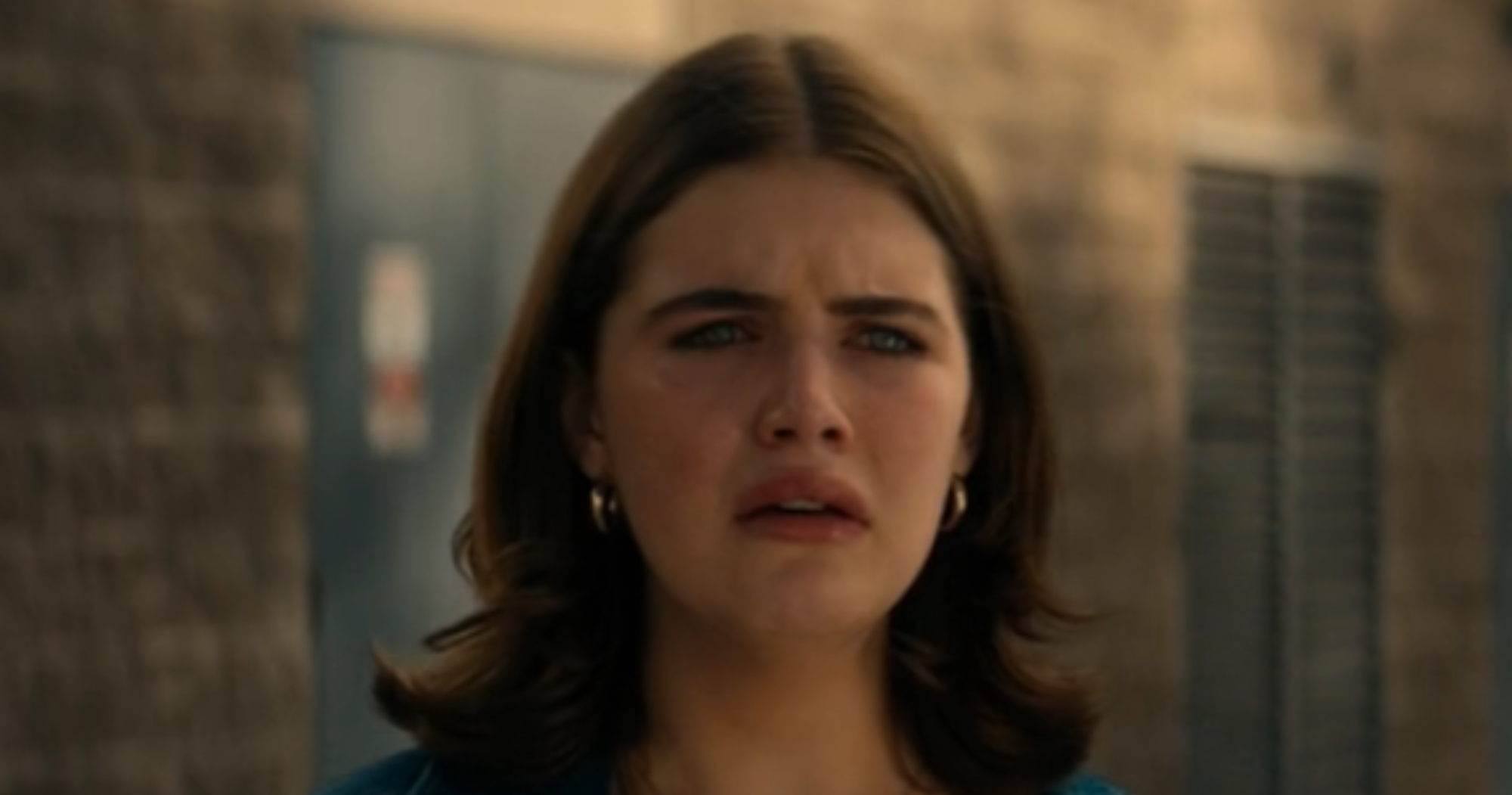
What Actually Happens in “The Breakup”
Episode 4, titled “The Breakup,” opens a door most romance narratives keep firmly shut. Hannah asks Garrett to help her orgasm, prefacing the conversation with a specific kind of warning: she’s about to tell him something heavy, and she needs him not to dwell on it. What follows is her disclosure that she was drugged and raped in high school. The camera holds on Garrett’s face long enough to register the shift – shock, then something quieter – before Hannah redirects with precision: “I’m not fragile. I don’t need your pity. I don’t need you to be my therapist.”
That framing is doing real work. Survivors in film and television are so frequently written as defined by their trauma – fragile, haunted, in need of rescue – that Hannah’s active refusal of that role lands differently. She is the one setting the terms. She is the one naming what she needs and, more pointedly, what she doesn’t.
Garrett’s response is simple to the point of being almost startlingly uncinematic: “Okay, I’ll do it… You’re my friend, and you need me.” No dramatic pause, no male savior energy, no tearful vow to track down the person who hurt her. Just a straightforward agreement from someone who heard her and chose to show up on her terms.
The Scene That Followed – and Why It Matters
What comes next is the sequence that has viewers stopping mid-scroll to talk about it. Hannah and Garrett touch themselves in front of each other – an intimate, explicit moment that is also, in the context of everything Hannah just disclosed, an act of reclamation. Before it gets there, though, the episode earns it. While making out with Garrett on his bed, Hannah begins struggling to stay present. She wants to push through. Garrett stops them.
His gentleness in that moment is not performed heroism. It reads as instinct – someone paying attention, someone who actually listened when Hannah spoke. That distinction matters because the scene doesn’t reward Garrett for his behavior or position Hannah’s healing as something that happens to her. The writing keeps her at the center of her own story.
Why This Lands Differently for Survivors Watching
For anyone who has experienced sexual assault, watching Hannah’s disclosure in real time carries a specific kind of physical weight. Breath tightens. The body braces. The question running beneath every such scene in film and television is the same: how is this going to be mishandled? The genre track record is not reassuring – assault is regularly used as backstory shorthand, a dramatic accelerant that exists to give male characters someone to protect.
Off Campus doesn’t do that. Hannah’s history doesn’t exist to motivate Garrett. It exists because Hannah exists, fully, with a past that shapes how she moves through intimacy and what she needs from the people close to her. The show treats that as ordinary human complexity rather than a plot device, which is rarer than it should be.
There is also something specific about the way Hannah articulates her own needs out loud – not to a therapist, not in a voiceover, but directly to the person she is becoming intimate with. That kind of self-advocacy, depicted as both normal and effective, is not common in mainstream streaming content. The scene functions almost as a model: this is what it can look like to communicate around trauma with a partner, and this is what it looks like when that partner actually listens.
The contrast with how the same subject gets handled elsewhere is hard to ignore. Assault disclosures on television tend to produce one of a few predictable responses – the crying scene, the rage scene, the overprotective spiral. Garrett’s quiet “okay” sidesteps all of it, and the show trusts that simplicity to carry the moment. It does.

The Bigger Picture for the Show
None of this erases what Off Campus primarily is: a show built around romantic and sexual tension, one that has been drawing audiences in with its charged pacing and the specific electricity between its leads. The hockey backdrop, the campus setting, the slow-burn structure – these are the bones of a genre piece, and the show is good at all of it. If you’re looking for a recommendation on that front, it delivers.
But Episode 4 is the moment the show earns something beyond genre competency. Hannah Wells, as written and performed by Ella Bright, is not a survivor archetype. She is a person with a history who decides, on her own schedule and in her own words, to let someone in. Garrett doesn’t become a better man because of her disclosure. He just – already – knows how to be a friend. That the show frames that as the goal, rather than as extraordinary, says more about what’s been missing from mainstream storytelling than any single scene could fully capture.
Whether the rest of the season maintains that standard – or whether this turns out to be the one episode that got it right – is the question hanging over the remaining episodes now.