




The Bags Were Packed. The Brain Was Not.
The Canadian Rockies have a way of making your inbox feel like a distant, embarrassing problem. That realization didn’t arrive immediately – it took about an hour on the road from Calgary, somewhere between the point where the mountains started crowding the horizon and the moment cell service gave up entirely, for the weight of perpetual busyness to actually loosen. The trip was a three-day invitation from Moxy Banff and Marriott Bonvoy Moments: Lake Louise, Moraine Lake, the Bow River, and the surrounding wilderness of the Canadian Rockies, all of it waiting on the other side of a flight that had, remarkably, begun on the right foot.
For once, the underwear count was correct.
Arriving in Canada already felt like a personal victory – clothes coordinated, toiletries confirmed, nothing forgotten. A self-described chaotic Type B traveler, getting the packing right signaled something. Not discipline, exactly, but readiness. What hadn’t been packed, though, and what no amount of organizational effort could leave behind, was the specific low-grade anxiety of someone who has spent years being very good at producing things and increasingly poor at simply existing in a moment without mentally drafting the next one. Even vacations had become something to optimize. This one was supposed to be different.
Two Intentions, One Camera, and a Decision to Do Scary Things
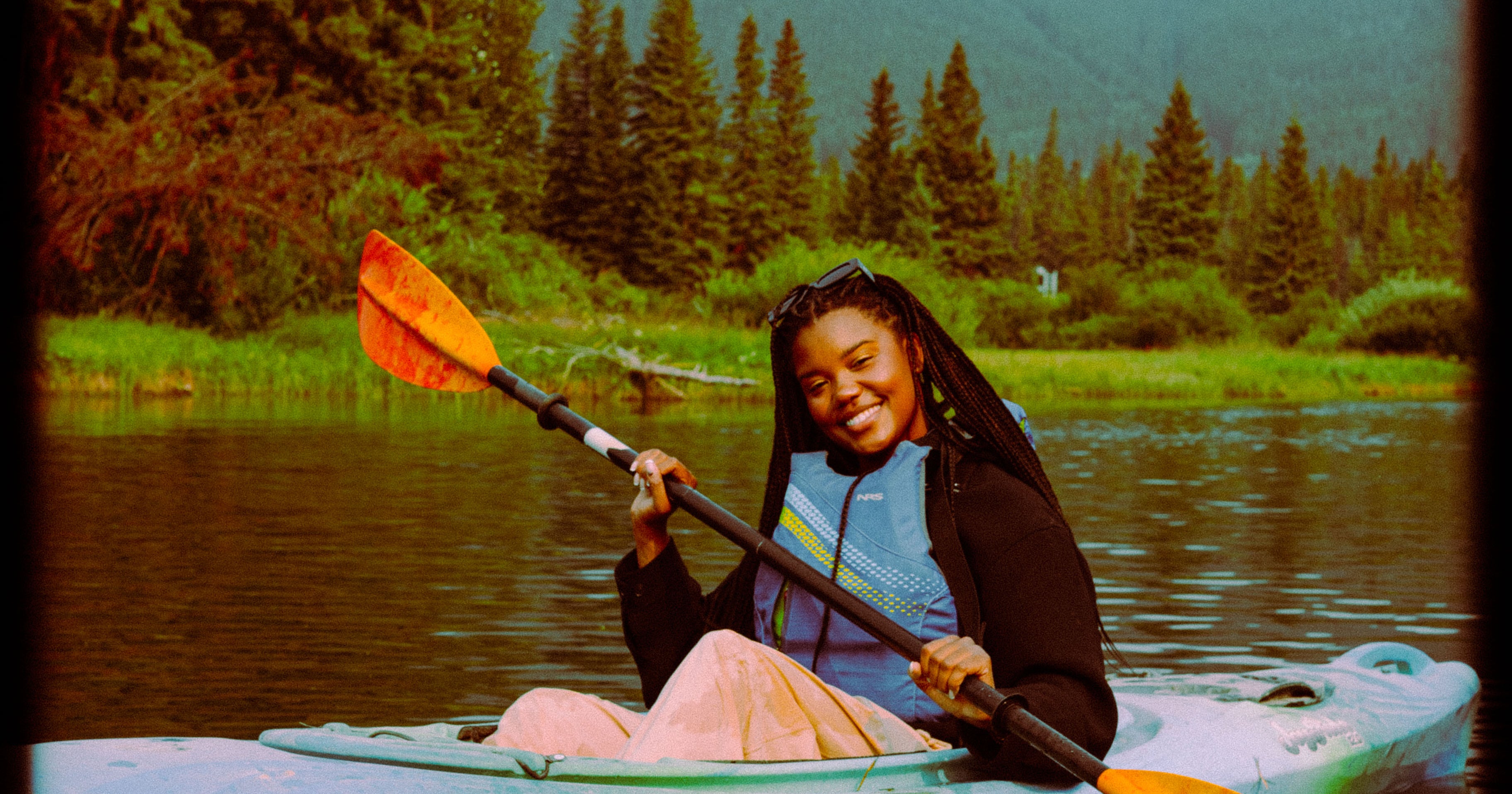
Somewhere over the flight path, in the particular suspension of consciousness that long-haul window seats tend to produce, two intentions took shape for the trip ahead. The first was presence – not the performative kind, not the kind that still has one eye on a to-do list, but the kind that actually registers the texture of bark, the sound of water moving over rock, the specific way a bee lands on a flower. Photography became the mechanism for that. Before deadlines consumed most available hours, a camera had been one of the primary tools for making sense of the world. Bringing it to Banff wasn’t nostalgia; it was a recalibration, a decision to let the act of framing a shot force genuine attention onto whatever was in front of the lens.
The second intention was blunter: do something frightening. Before the trip had even begun, there was already a list forming – activities that would have been easy to decline, excuses that would have been reasonable, opt-outs that productivity culture quietly trains people to accept as efficiency. This trip was structured around saying yes instead, specifically the kind of yes that produces a physical response before the rational brain can intervene.
Moxy Banff, the hotel hosting the stay, sits within reach of terrain that makes comfort-zone rhetoric feel literal rather than metaphorical. The Canadian Rockies don’t offer much room for half-measures. Lake Louise alone – glacially fed, surrounded by peaks that treat human scale as a minor footnote – has a tendency to reframe whatever felt urgent forty-eight hours earlier. Moraine Lake operates similarly. The Bow River moves at its own pace, indifferent to schedules. Three days in this landscape, with a camera and a stated commitment to yes, was either going to work or produce an excellent story about why it didn’t.

What the Mountains Actually Require of You
There is a specific kind of exhaustion that comes not from physical effort but from the continuous management of attention – the splitting of focus across notifications, deadlines, and the ambient noise of professional obligation. It is the defining condition of a certain kind of modern worker, the person who is technically always available and therefore never fully anywhere. Banff, by geography and by the inconvenience of its cell coverage, makes that split harder to maintain. The mountains don’t negotiate.
What the Canadian Rockies provide instead is scale. Standing near Moraine Lake or tracing the edge of the Bow River, the body registers something the mind resists during ordinary weeks: that most of what feels urgent is actually just loud. The work waiting back home was still there, of course. The notifications were accumulating. None of that had changed. What changed was the distance from which it could be viewed – not dismissed, not romanticized away, but held at a proportion that felt closer to accurate.
The camera helped. Photography as a practice demands a quality of attention that multitasking destroys. You cannot frame a shot while composing a mental email. You cannot chase the right light and simultaneously rehearse a conversation you need to have on Monday. For three days along Lake Louise, through the terrain around Moxy Banff, and down toward the Bow River, the act of looking for images worth capturing meant actually looking – at the mountains, at the water, at the specific quality of afternoon light in the Canadian Rockies, which is not like light anywhere else.
The Out-of-Office Reply as a Radical Act
Marriott Bonvoy Moments structured the three days around access and experience – the kind of itinerary that requires showing up rather than spectating. That requirement, to actually be physically present and engaged rather than adjacent to something interesting while scrolling, turned out to be the most effective intervention available. You cannot half-attend a landscape like this. The Rockies charge the full admission of your focus, and in exchange, they make a strong case that the person you are when you are genuinely present – the one who notices the bees and the textures and the light – is a more functional version than the one who is always preparing for what comes next.
The trip started with packed bags and the right amount of underwear. It ended with something harder to inventory – the specific, nagging question of why it took a flight to Canada and the deliberate removal of cell service for presence to feel like an option rather than a luxury.