





A Joyful Film That Earns Its Tears
Animated films have spent years chasing the emotional gravity they once held effortlessly, and Forgotten Island arrives as a reminder of what that weight actually feels like. The film follows best friends Jo, voiced by H.E.R., and Raissa, voiced by Liza Soberano, who wake up stranded in Nakali – a mysterious world rooted in Filipino folklore – with no memory of the night before. Think The Hangover‘s amnesiac chaos filtered through the emotional texture of Eternal Sunshine of the Spotless Mind, and you’re somewhere in the neighborhood.
The stakes sharpen quickly: if Jo and Raissa can’t find their way home, they risk losing not just their memories of Nakali, but of each other entirely.
Entertainment writers Bernice Corral and Rachel Choy watched the film and sat down to unpack why it landed so hard – from its animation choices to the cultural conversation it quietly starts. Their verdict, shared openly, is that Forgotten Island is the kind of film that sticks long after the credits roll.
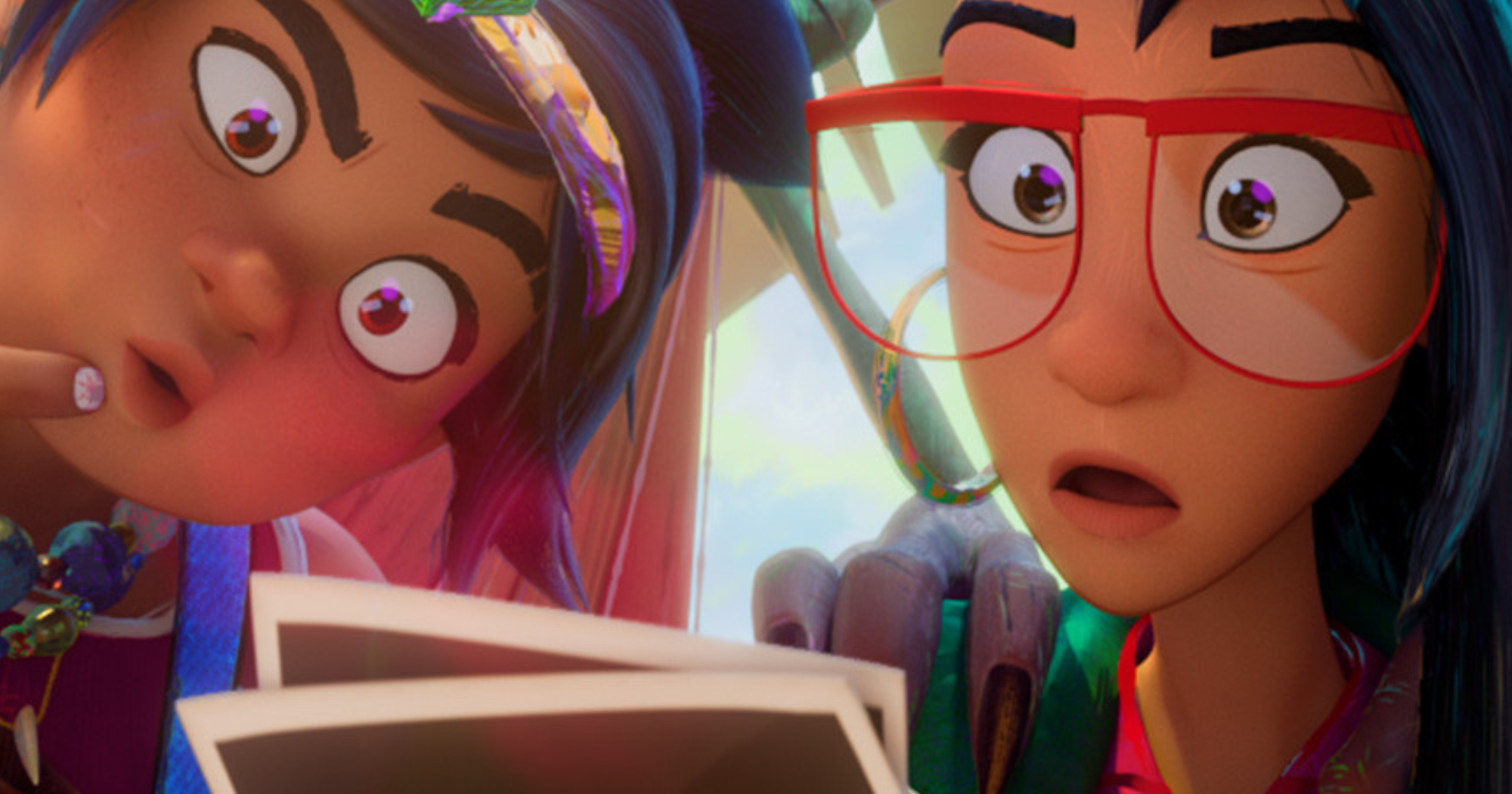
The Animation Speaks Before the Story Does
Bernice Corral’s first reaction wasn’t to the plot – it was to how the film looked. She draws a direct comparison to Spider-Man: Into the Spider-Verse, citing the visual style as something that immediately separates Forgotten Island from the wave of competent-but-flat animation flooding streaming platforms. That’s a meaningful benchmark. Spider-Verse didn’t just win an Oscar; it redefined what audiences expected from the medium, and Corral’s instinct to reach for it suggests Forgotten Island is operating at a similar level of visual ambition.
What makes the aesthetic choice more than cosmetic is the context behind it. Corral points out a pattern that has persisted in Hollywood productions for decades: whenever Southeast Asia appears on screen, cinematographers and colorists routinely apply a yellow-orange filter over the footage – a visual shorthand that frames the region as impoverished and othered. Rachel Choy agrees directly, calling it what it is: racism embedded in post-production choices that have gone largely unchallenged in mainstream film. The damage is subtle but cumulative, shaping how Western audiences understand an entire part of the world.
Forgotten Island does the opposite. The Philippines in this film is rendered in full, vibrant color – rich and alive rather than flattened into a poverty narrative. For Corral, seeing that on a big screen wasn’t just aesthetically satisfying. It was meaningful in a way that’s harder to articulate and easier to feel.

A Cast That Carries the Film’s Cultural Weight
Corral was tracking this film from the moment Liza Soberano’s involvement was announced. Soberano, a Filipino actress who built her career in the Philippines before making deliberate moves toward Hollywood, represents something the film leans into rather than papers over. Her presence isn’t incidental casting – it’s part of why Forgotten Island feels earned rather than performative in its cultural representation.
The wider cast reinforces that. H.E.R. leads the film alongside Soberano, with Lea Salonga, Dolly de Leon, and Manny Jacinto filling out the ensemble. That lineup – spanning Grammy-winning musicians, internationally recognized stage talent, and a The Good Place breakout – doesn’t read like a diversity checklist. It reads like filmmakers who actually went looking for the right people. Lea Salonga, who has spent decades as one of the most recognized Filipino voices in musical theater globally, brings a generational weight to the project. Dolly de Leon, whose work in Triangle of Sadness introduced her to an entirely new international audience, adds another layer of credibility.
For Corral, who has followed Soberano’s career across continents, watching her anchor an animated feature of this scale lands differently than watching another Hollywood production nod politely toward diversity. This is a film built around Filipino stories, Filipino voices, and Filipino visual identity – and the audience can feel the difference between that and a film that merely includes.
Corral and Choy also raise the question of where Forgotten Island sits in the broader animation conversation. Pixar, once the studio whose films arrived with the expectation of collective emotional devastation, has had a more uneven recent run – a shift both writers acknowledge without belaboring it. Forgotten Island steps into that space not by copying Pixar’s formula but by building something that taps the same emotional frequency through a completely different cultural lens. The friendship at the film’s center – Jo and Raissa navigating monsters, creatures, and the threat of losing each other – carries the kind of genuine stakes that make animated films matter to adults and children equally.
What the Film Actually Asks of Its Audience
At its core, Forgotten Island is a film about memory and what we lose when it fades. Jo and Raissa move through Nakali encountering creatures drawn from Filipino folklore – a world most Western audiences are encountering for the first time through this lens. The mythology isn’t decorative. It’s the architecture the story is built on, and the film treats it with the seriousness it deserves rather than exoticizing it for easy spectacle.
Corral describes the film as joyful and hilarious while also noting it will move people to tears – a combination that’s harder to pull off than it sounds. Films that try to do both often collapse into tonal inconsistency. The fact that Forgotten Island reportedly holds that balance is either its greatest achievement or the claim that will face the most scrutiny once wider audiences weigh in.
Whether the film becomes the breakout hit Corral and Choy are anticipating depends partly on distribution reach and partly on word-of-mouth from exactly the kind of conversation they’re already having – Filipino audiences seeing themselves rendered with color and care, and everyone else encountering a world of folklore they didn’t know they needed. The film ends with Jo and Raissa racing against the possibility of forgetting. The audience, apparently, has the opposite problem.