





I have spent years dismissing supplements as expensive theater – pretty bottles, zero results, and a lot of wishful thinking baked into the marketing. Then NMN kept showing up everywhere I turned, and eventually the science got loud enough that I stopped scrolling and started paying attention.

What NMN Actually Is, and Why I Finally Cared
The full name – nicotinamide mononucleotide – is a mouthful, but the mechanism is straightforward. NMN replenishes NAD+, a coenzyme that drives cellular energy production and falls off steadily as we age. Lower NAD+ levels are linked to slower cellular repair, a sluggish metabolism, dull skin, and that low-grade fatigue that starts feeling normal somewhere in your thirties. The pitch isn’t aesthetic, at least not on the surface. It’s biological.
I first heard about NMN through the longevity crowd – The Skinny Confidential, Bryan Johnson’s very public health experiment, the usual suspects. I filed it away. It wasn’t until I listened to David Sinclair on Diary of a CEO that I actually sat with the science long enough to feel like I understood what I was considering. Sinclair’s argument isn’t that NMN reverses aging. It’s that aging operates on a biological clock that can, to some degree, be influenced – and that starting early matters far more than starting after you feel the decline.
I’m in my thirties, I feel genuinely healthy, and my interest in longevity is less about looking good next month and more about who I want to be at ninety. That framing is what made NMN make sense to me. Not a shortcut. Not a transformation promise. A cellular investment, the kind you make before you need it.
I bought my first bottle of Novos Boost at Erewhon – more on that price point shortly – and committed to 30 full days before forming any opinion. I was not expecting to have one this quickly.
30 Days In: What Actually Changed
Novos Boost is positioned squarely in the serious-supplement category. The brand’s core argument is that aging is not inevitable so much as it is biological, and that biology responds to what you put into it. At $44 a bottle, it’s not cheap – but it’s not the most expensive thing I’ve ever bought at Erewhon, which is a sentence that says something about Erewhon and something about me.
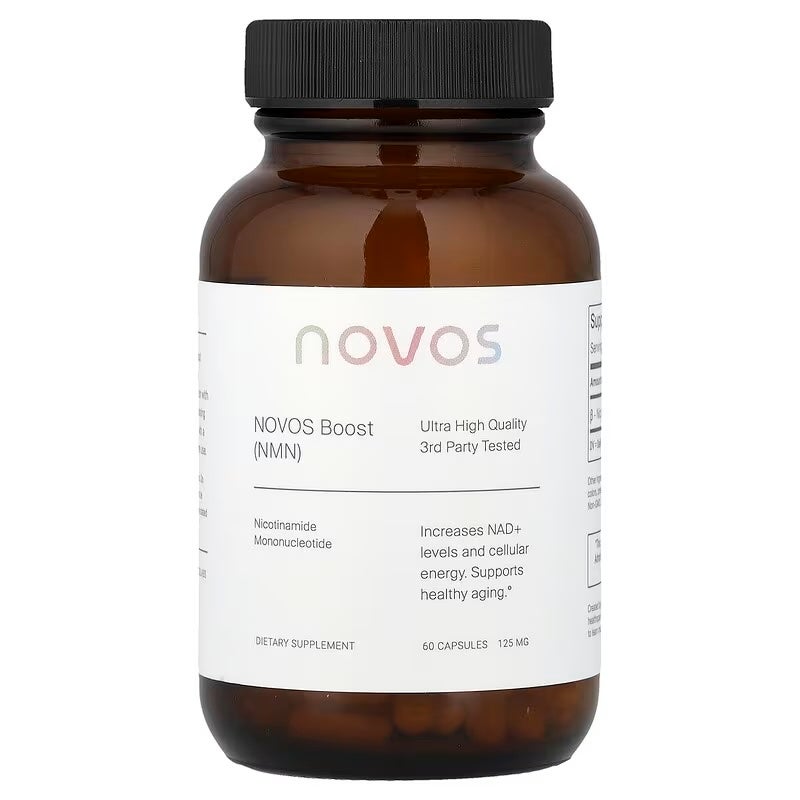
Before I got to results, I had to reckon with something I’d been half-ignoring for years: third-party testing. I’d heard the term, nodded along, and moved on without really understanding why it mattered. Dr. Rhonda Patrick changed that, also on Diary of a CEO. Her explanation was blunt – supplement brands can legally print almost anything on a label, including ingredients that may not actually be present in meaningful amounts inside the capsule. She used creatine gummies as a specific example: most of them contain little to no actual creatine. The label means nothing without verification. That was the moment I stopped treating “third-party tested” as a marketing badge and started treating it as a baseline requirement.
Which is why I wasn’t going to hand over $44 to just any brand making NAD+ claims. Novos Boost carries third-party testing, and that due diligence was part of why it cleared my filter. The supplement space is genuinely unregulated in ways most consumers don’t fully appreciate, and the gap between what a label says and what a capsule contains can be significant. Knowing the product has been independently verified changes the risk calculus.
The results I noticed were not what I expected – not in category and not in timeline. By week two, my energy felt more consistent across the day, without the mid-afternoon drag I’d started to accept as structural. Sleep felt deeper, though I didn’t change anything else in my routine. My skin looked less tired. Then, around day 25, a stranger complimented my neck. Not my hair, not my outfit – my neck. Specifically the quality of the skin there. It was such a specific, unrequested observation that I didn’t know what to do with it. I still don’t, entirely.
I want to be careful here. Thirty days is a short window. I didn’t run bloodwork before and after. I didn’t control every variable. What I can say is that the changes I noticed were real and specific enough that I didn’t feel like I was narrating a placebo into existence. The neck compliment came from someone with no stake in my supplement routine. That detail has stayed with me.
The Part Where We Talk About Buying It at Erewhon
Purchasing Novos Boost at Erewhon is a choice that comes with a financial consequence. Erewhon applies its own markup to everything it carries, and wellness products are not exempt. If you are committed to NMN as a long-term protocol – and the science suggests it works better as a sustained practice than a short-term experiment – buying through Erewhon every month will add up in ways that may not be sustainable. The brand’s direct website is worth checking for subscription pricing.
What I keep returning to is that the longevity conversation has shifted. It used to live in biohacker forums and academic papers. Now it surfaces in mainstream podcasts, celebrity wellness routines, and, apparently, supplements you can grab between the $22 smoothie and the adaptogen-laced chocolate bark. The question isn’t whether NMN deserves serious attention – the research behind NAD+ depletion and aging is substantial and growing. The question is whether the product in the bottle actually matches what the label promises, and whether a stranger commenting on the quality of your neck skin at day 25 is enough of an answer.